
Navigator logo

Spend Money, Make Money?

This afternoon, the Ontario government tabled its 2023 fall economic statement titled “The 2023 Ontario Economic Outlook and Fiscal Review: Building a Strong Ontario Together.” Below, you will find a summary of the key points from the statement.

Need to Know

  • The Ontario government is propping up an all-new $3 billion Ontario infrastructure bank, targeted at housing, long-term care facilities, energy, housing, municipal infrastructure and transportation projects.
  • Affordability is front and centre with the extension of the government’s 10-cents-a-litre gas tax cut until June 2024 and taking the provincial portion of the HST off of purpose-built rental housing projects.
  • Inflationary pressures, high interest rates and geopolitical unrest has led to Ontario reporting a deficit of $5.6 billion for 2023-24, four times the $1.3 billion it projected in its March budget earlier this year, delaying a balanced budget to 2026.

Why It Matters

  • The channel changer: The PCs hope the splash of a new infrastructure bank will not just be a distraction from Greenbelt politics, but reunite public opinion around the urgency of getting housing built.
    • Ontario is learning from the pitfalls of its federal cousin and giving its new bank a clear, independent mandate to get needed housing and infrastructure built with the help of Canada’s top pension funds and other leading institutional players, who are conveniently located on their doorstep.
  • The big picture: With the proposed bank and more money for Invest Ontario and a flow-through share tax credit, the PCs continue to signal that Ontario is “open for business” and ready to support the $26 billion in new investments in its EV and battery sector.
  • The stretch goal: The government is temporarily abandoning the path to a balanced budget and their fiscally conservative principles with Ontarians reporting cost of living as their top issue and struggling to pay higher interest on mortgages.

What’s new

Ontario Infrastructure Bank

The provincial government is setting up a new arms-length $3 billion infrastructure bank to attract private money from institutions, such as pension and insurance funds. Going into large projects with these institutional investors reduces the risk of these projects and helps attract more private capital.

Zoom in: The bank’s initial focus will be primarily on housing, but also on long-term care, energy and transit. The government has also said the bank would help enable more Indigenous-sponsored projects.

Zoom out: Several other jurisdictions have used infrastructure banks to sponsor large infrastructure projects, including California, UK, Australia and Germany.

The bottom line: With differing opinions on the success of the Canada Infrastructure Bank, it will be up to the provincial government to demonstrate results – and more importantly – value for money.

What’s next: In the near future, we can expect the province to unveil the bank’s governance structure, including its interim chair board and leadership team.

Honourable Mentions

  • Allocating an additional $100 million for Invest Ontario, the province’s investment attraction agency, to support businesses and attract jobs in the province.
    • The agency is focused on attracting investments in advanced manufacturing, life sciences, and technology.
  • Enhancing the Ontario Focused Flow-Through Share Tax Credit to serve as a stimulus for critical minerals exploration.
  • Implementing a Target Benefit Framework that will serve to regulate retirement plans primarily seen in the skilled trades sector.
  • Introducing legislative changes to strengthen the province’s litigation when it comes to holding international pharmaceutical companies accountable for the opioid crisis.
  • Introducing a $200 million Housing-Enabling Water Systems Fund (over three years) to support municipalities, prevent flooding, and enable housing development.
  • Matching the federal government with a legislative (or excise) vaping tax to promote better health outcomes.
  • Enacting certain capital markets reforms through legislative changes to the Securities Act and Commodity Futures Act.
  • Previewing that the results of the ongoing tax reform consultations will be shared as part of Budget 2024.

By the numbers

  • The new deficit projection for 2023-24 is now $5.6 billion, $5.3 billion next year, and a “modest surplus” is expected to be reported in 2026.
  • Interestingly, the government added a top-up of $2.5 billion to the contingency fund, in addition to the $1 billion reserve fund.
  • The government is investing a total of $185 billion over 10 years in its capital plan to build more hospitals, schools, transit, highways and long-term care homes. There are no additions or changes to the capital plan since the March budget.

ICYMI

As a reminder, the government announced the “big ticket” items from FES earlier this week, including:

  • Extending the gas tax cut until the end of June 2024.
  • Axing the province’s cut of HST (harmonized sales tax) on purpose-built rentals to incentivize housing construction.
  • Expanding breast cancer screenings to women 40+ starting in Fall 2024.

Next Steps

  • Budget consultations: The Finance Minister starts trekking across the province next week for budget consultations.
    • With the Fall Economic Statement unveiled, the province will quickly turn its attention to preparing the 2024 Budget, which means pre-budget consultations are right around the corner.
    • While more details on formal consultations will be released in the coming weeks, stakeholders can already start sending their ideas to submissions@ontario.ca to be considered.
  • FES legislation: The government will be working to get the FES bill and other key pieces of legislation on the docket this fall passed before the winter break hits in early December.

Stay Tuned

Our team will keep our eyes peeled on the FES legislation and the new Ontario Infrastructure Bank.

If you have any questions about today’s announcements, please reach out our team of political veterans at info@navltd.com.
Federal Budget 2023

A (Too?) Timid Response to Challenging Times

Budget 2023 notionally delivers the response that had been expected of the government to address affordability issues facing Canadian families, reflects recent intergovernmental agreements on health care funding, and addresses the US administration’s “green industrial policy” investments. In actuality, the budget seems too timid a response to too many disparate policy and political imperatives to make a meaningful impact on any single one of them.

From a political perspective, the suite of measures aimed at addressing the rising cost of living is understandable. Exclusive public opinion data collected by Discover by Navigator in the days leading up to today’s budget confirm that addressing cost of living issues was the top priority of Canadians at 39 per cent, beating out lowering taxes (21 per cent) and reducing government spending (20 per cent). These measures will also serve to buttress the deal negotiated a year ago with the New Democratic Party, notably the additional investments in dental care – a long-standing NDP priority.

Like Budget 2022, which was shaped by rising inflation and Russia’s invasion of Ukraine, Budget 2023 is more a response to outside pressures than the expression of the Government of Canada’s desired policy direction. The question is whether the measures announced today will constitute a robust enough response to the Biden Administration’s Inflation Reduction Act, the demands of our increasingly strained health care system or the still-too-heavy burden of the rising cost of living on family budgets to make a meaningful; difference. Only time will tell, which may, in the end, be the one thing the government was playing for in designing this budget.

You can download our budget analysis here.

For more analysis, or support engaging government on any of the budget announcements, contact your Navigator team or reach out at info@navltd.com

Welcome to The Push Back: Setting Ballot Box Benchmarks

Welcome to The Push Back, Navigator’s Ontario elections analysis with a crisis communications twist. We’re bringing our proprietary insights and crisis communications expertise to bear on the issues of the election, from the hubbub of social media to how political messages are landing with voters. We identify exactly what will make or break Ontario’s political leaders and parties as they vie for the governing seat at Queen’s Park.

Ontario’s political parties are already gearing up for the campaign trail. Last week, the PCs released the 2022 Ontario budget, only to have the legislature adjourn without passing the document. It’s clear the Ford government hopes to make their budget a ballot box question as the province approaches election day on June 2.

Research Insights | Ballot Box Questions

Each week, we will ask Ontario voters whether they think political parties are gaining or losing ground on the issues they care about most. In this edition, we’re establishing a benchmark of what issues matter most to Ontarians going into the election, while taking a peek at some of the wedge issues already on the table.

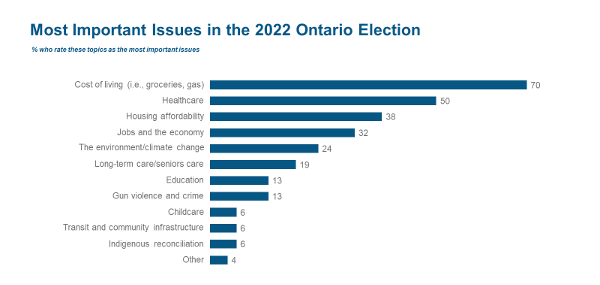
The cost of living is the top concern for voters by a landslide with 7 in 10 Ontarians identifying it as their most important issue in this election. The issue lands 20 points over health care, just as the focus on the pandemic begins to diminish. We can anticipate this issue will drive real competition among parties to prove who has the best plan to make life more affordable for Ontario voters. Surprisingly, transit, child care, and education are all taking a back seat (for now) in this election.

We also did some testing on two hot button issues: housing and the proposed Highway 413 project. Of the housing policies announced by political parties to date, four NDP policies scored highest with over 70 per cent support, including closing loopholes on renovictions (81 per cent), building 69,000 new affordable homes over 10 years (81 per cent), raising property taxes on the rich (72 per cent) and targeting provincial supports to first-time home buyers and renters (72 per cent). While the Liberals have not yet released their full housing platform, their promise to end the practice of Ministerial Zoning Orders (MZOs) received only 48 per cent support. Some good news for the PCs: on Highway 413, we found broad support from 905 voters, with 57 per cent saying they support the project, with overall provincial support for the project resting at 45 per cent.

What We’re Watching

Looking at the week ahead, here are a few things on our radar that could generate some push back between the contending parties.

  • Two days before writ drop, Premier Doug Ford and Prime Minister Justin Trudeau made a major $3.6 billion auto investment announcement at Stellantis Monday afternoon in Windsor. Stellantis will retool and modernize their plants in Windsor and Brampton, and build two new research and development centres, to support electric vehicle production.
  • Unlike their federal cousins, the Ontario Liberals and NDP have ruled out a coalition if they lose to Ford’s PCs in June.
  • Will cheap transit win out over toll-free highways? Del Duca’s Liberals promised they would reduce transit fares to $1 per ride until 2024.

Hold My Beer

On April 25, the NDP released its election platform, and as expected, they were instantly met with criticism from other parties. The Liberals were quick to criticize the platform’s launch by pointing out a seemingly undetected mistake in the cover image – a fellow casually chugging his beer. The Liberal war room was quick to poke fun at the oversight, claiming that’s why the NDP’s “platform math is always so wonky.”

NDP leader Andrea Horwath pushed back by sharing a photo of her enjoying a beer and responded to criticism saying, “After a long day it’s nice to relax with a cold beverage. Cheers, @OLPWarRoom!”

Social Media

Andrea Horwath’s post saw high traction with a total of 1,406 engagements, significantly higher than the Liberal war room’s post with only 261 engagements. Top influencers engaging with these posts include many NDP candidates supporting Andrea Horwath. MPP Catherine Fife shared Horwath’s post and NDP candidate for Nipissing, Erika Lougheed also shared her support by posting a photo of herself enjoying a beer.

The Push Back Verdict – White Noise

We would label this exchange as “white noise,” something that won’t move votes for any side. BUT we give a tip of the hat to Ms. Horwath for effectively pushing back on her critics. Two admirable traits politicians can use to connect with voters are using some humour and not taking oneself too seriously. Ms. Horwath does both here and we don’t think this little incident will impact the party on the campaign trail.

Budget ‘Bait & Switch’

Finance Minister Peter Bethlenfalvy came under fire after not being clear on whether he would commit to re-introducing the same budget if the PC government is re-elected. While the Premier’s office and Ministry of Finance were quick to clarify and indicate the budget will be reintroduced, opposition parties, media and advocacy groups pushed back on the government for not standing behind the commitments made in the document.

NDP leader Andrea Horwath called out the PCs for the “bait and switch” budget, which she believes would result in cuts if they were re-elected. Horwath’s pressure on the PCs budget generated increased media attention, but let’s see how the coverage unfolded.

Mainstream Media

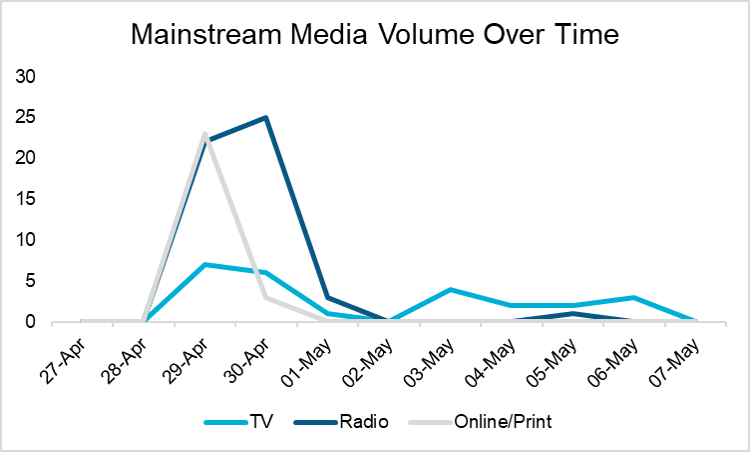
There have been 102 media stories covering this issue since the budget was announced. Coverage is provincewide with some regional outlets syndicating a Toronto Star story. Key outlets reporting include CTV, the Toronto Star, Global News and CityNews.

Social Media

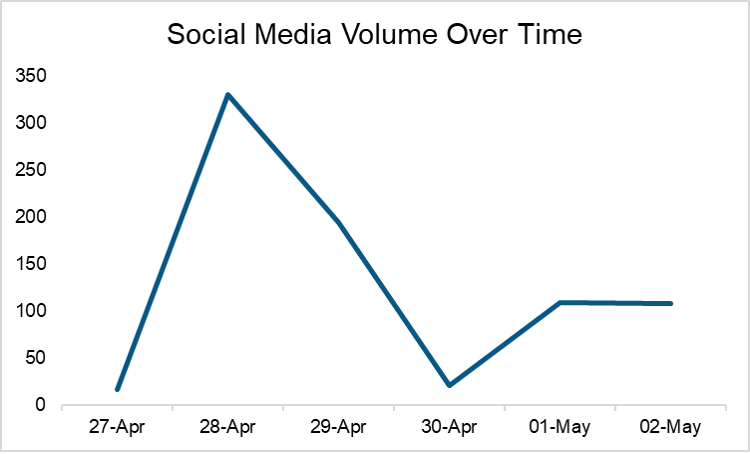
There were 779 mentions on social media regarding the issue from April 27 to May 2. Engagement on social media channels peaked on April 28, the day the budget was announced. Social media conversation was predominantly held via Twitter. Key influencers engaging on this issue include the Paramount Fine Foods CEO Mohamad Fakih and the grassroots movement against the Ford government NotOneSeat, who openly criticized Minister Bethlenfalvy for his refusal to commit to the budget.

The Push Back Verdict – Rolling Stone

We would label this exchange as a “rolling stone” that could end up impacting the PCs’ credibility on the election trail. Given the media traction, we think the NDP will continue to hammer the PCs for introducing a budget they never intended to pass.

We know the opposition can make political hay out of this issue, but it remains to be seen whether it will resonate among voters. We’ll stay tuned and provide an update if we see any movement on this front.

In Other News…

  • ICYMI: All three parties released new campaign ads last week—some were heartfelt, and others, less so.
  • This past weekend, the PCs and NDP unveiled their campaign buses and the Liberals kicked off their campaign at Del Duca’s nomination meeting in Vaughan—Woodbridge. While reporters will be welcomed on an NDP media bus, there will be no such conveniences for the gallery following the PCs and Liberals on the campaign trail.
  • In a new hit ad against Del Duca, the Labourers’ International Union of North America (LiUNA) officially endorsed Ford for Premier, suggesting the Liberals were not ready to lead.
  • As inflation rates grow, Del Duca announced his commitment to make mealtime more affordable. On Friday, the Liberals promised to cut the eight per cent provincial portion of HST on prepared foods.
  • Del Duca announced the Liberal Party’s commitment to revolutionize long-term care in the province—much like Horwath’s NDPs, he vowed to ban for-profit facilities and emphasize homestyle care.
  • As part of their platform, the NDP pledged a four-year tax freeze for low and middle income families. Noted by Horwath, this move is not meant to starve the provincial treasury. Rather, the NDP plan to pay for it by taxing Ontario’s wealthiest corporations and highest-income individuals more.

Ontario Budget 2022

This afternoon, the Ontario government unveiled its 2022 budget entitled “Ontario’s Plan to Build.” If some of the budget items look familiar, it’s because they are. Many of the initiatives were announced in the weeks prior to the budget, with the tax initiatives and a few other pieces excepted.​

Let’s be honest: this is an election budget, a pseudo-platform for the PCs to run on in the coming weeks. In the document, the PCs clearly carve out the battle lines. ​

They’re going back to running on their traditional strengths when it comes to growing jobs and the economy through a Critical Minerals Strategy tied to Ring of Fire development and a whopping $12 billion in electric vehicle deals signed over the past few months. They’re swinging for labour votes with the expansion of Ontario’s low-income tax credit, investments in skills training and upping the minimum wage to $15.50 per hour this fall. ​

Contrast with the opposition is very apparent throughout the document and in the Minister’s speech. In a bid for suburban votes, the PCs have staked their claim on supporting contentious infrastructure projects like Highway 413 and the Bradford Bypass, daring the opposition to stop building roads that would help 905 commuters and workers. On another front, the PCs see delivering on their promises for more hospital beds, long-term care beds, and health human resources as more than just building the future of health care; it’s daring the opposition to say anything against efforts to keep the economy open amid a sixth wave of the pandemic. ​

With all the talk about inflation and cost of living, one important commitment is missing from this fourth-year budget is the middle-class income tax cut promised by PCs on the 2018 campaign trail. Will the other relief measures be enough to placate voters? Will affordability ultimately become the ballot box issue? Ontarians will have to find out for themselves on June 2. ​

You can download our budget analysis here.

If your organization is asking these questions, our team of political experts has the answers. Please reach out to start a conversation at info@navltd.com.

You can also stay in the know by subscribing to our complimentary Ontario elections updates here.