
Sally Housser joins CTV Power Play’s Strategy Session to react to the results of the Ontario election.
Aired on CTV News on June 8, 2018

Sally Housser joins CTV Power Play’s Strategy Session to react to the results of the Ontario election.
Aired on CTV News on June 8, 2018
What do the Ontario election results mean for organizations and the economy? Navigator crisscrossed the province to find out. Click here for our final report that compiles findings from eight focus groups in Ontario (North York, London, Sault Ste. Marie, and Oakville), as well as in-depth interviews with voters in eastern Ontario, with a focus on rural and smaller communities.
Colin MacDonald joins a panel of political commentators on CTV News to weigh in on the tight race as Ontarians head to the polls.
Values and integrity are shaping the new corporate agenda as stakeholders demand that corporate leaders demonstrate social responsibility. The relentless pursuit of accountability and collective morality can be exhausting, however… Navigator Consultant Arabella Goldring reviews some ethical options for rest and relaxation.
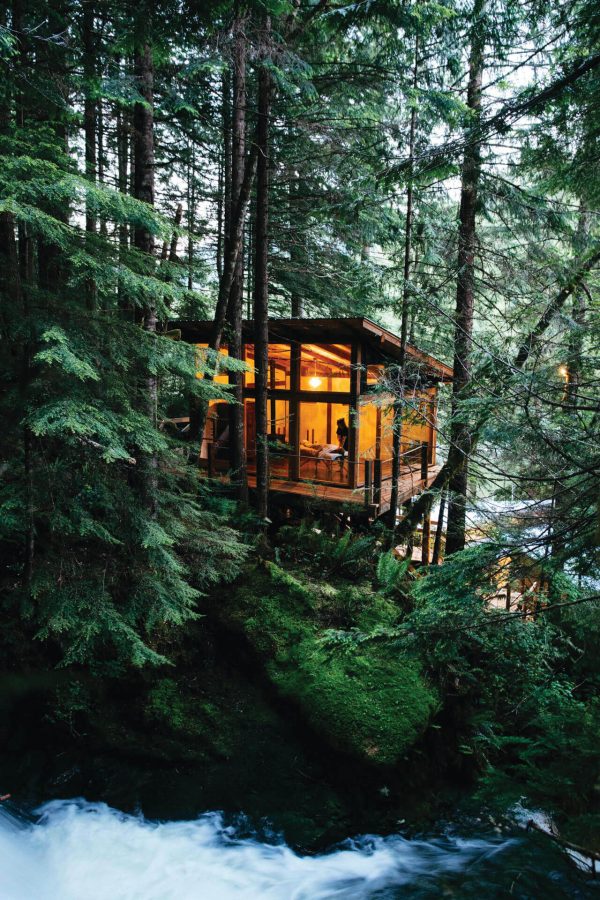
Stay in an inter tidal chalet at this wilderness adventure resort that adheres to sustainable tourism practices. At Nimmo Bay Resort in Port McNeill, B.C., guests can take advantage of activities from whale watching to glacier trekking and heli-hiking.
This eco-destination allows guests to return to nature in a part of southwestern Nova Scotia so remote that there is no cellphone service. Trout Point Lodge is a five-star inn located on a wooded estate that borders on the scenic Tobeatic Wilderness Area. The inn offers guests all of the amenities needed to put outdoor recreation and relaxation at the forefront of their vacation.
This all-season eco-lodge offers wilderness lovers a unique way to explore southern Ontario’s Algonquin Park, with limited impact on the local environment. Algonquin Eco-Lodge is powered by 100 per cent micro-hydro electricity, generated by its own waterfall. Hike, horseback ride or relax lakeside at this award-winning reatreat.
Hotel Sacacomie, a 90-minute drive from Montreal, provides cozy accommodations next to the Mastigouche wildlife reserve. Luxury meets the backwoods at this log cabin that hosts a spa offering a full range of services.
Architecture firms around the globe are increasingly committing to making more environmentally conscious decisions with their designs. Here are some examples of industry trailblazers:
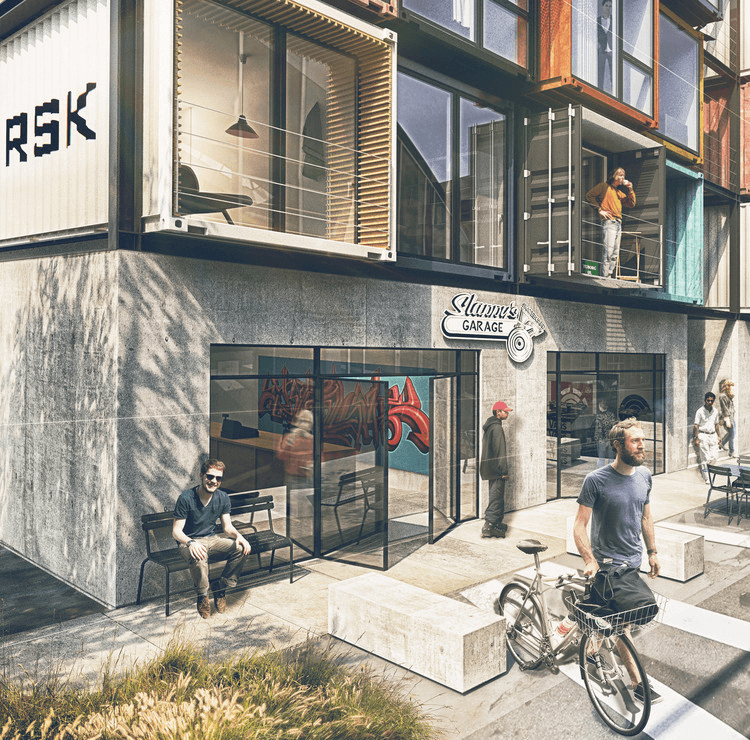
1 Beat Box housing built by Danish firm Arkitema includes 20 apartments in 48 shipping containers that revitalized a neighbourhood in Roskilde, Denmark. (Source: Danish Design Firm Arkitema Is Building an Apartment Complex from Shipping Containers)
2 For Dubai Design Week 2017, boutique Indian firm Fahed + Architects repurposed coil springs from discarded bed mattresses to build a temporary pavilion. The structure, which resembles a cloud-like form, was constructed out of 100 per cent recyclable material. (Source: Abwab D3 Pavilion 2017)
3 Japanese architect Shigeru Ban, famous for his quickly erected, inexpensive structures in disaster zones, built a replacement cathedral in Christchurch, New Zealand, after the city wasdevastated by an earthquake in 2012. The temporary cathedral, completed in 2013, was constructed out of 98 equal-sized cardboard tubes and eight steel shipping containers. (Source: Newly Released Photos of Shigeru Ban’s Cardboard Cathedral in New Zealand)
These popular farm-to-table restaurants are showcasing all that Canada has to offer:

Annalena
Vancouver | www.annalena.ca

Mallard Cottage
St.John’s | www.mallardcottage.ca

Pilgrimme
Galiano Island, B.C. | www.pilgrimme.ca

Market
Calgary | www.marketcalgary.ca

Wolf In The Fog
Tofino, B.C. | www.wolfinthefog.com
Zero Waste Home
By Bea Johnson
The Joy of Less: A Minimalist Living Guide
By Francine Jay
The Life-Changing Magic of Tidying Up:
The Japanese Art of Decluttering and Organizing
By Marie Kondo
As an alternative to buying all of the ingredients for a meal at the grocery store, why not opt for simplicity with a full meal in a box delivered right to your door? Try these meal-kit subscription services:
Delivers in: Quebec, Ontario, Manitoba, Saskatchewan, Alberta, British Columbia and the Maritimes
Price: $9.38 per meal/person
Delivers in: Quebec and Ontario
Price: $10.83 per meal/person
Delivers in: Ontario, British Columbia, Alberta, Saskatchewan, Quebec, Prince Edward Island, New Brunswick, Nova Scotia and Manitoba
Price: $10.95 per meal/person

Apple’s 2017 App of the Year, Calm facilitates mindfulness and meditation. This app offers guided meditation, sleep stories, breathing programs and relaxing music to help its users get better sleep.

Use this guided meditation app in moments of high stress. Headspace offers the basic breathing exercises and visualizations used by celebrities and business leaders alike to help manage stress.

Sporcle is an addictive trivia application that quizzes users on such subjects as sports, movies, television, music and geography. This app is sure to challenge your memory and exercise your brain.
Hey Jaime,
All of us love a bit of drama, especially when it involves some family intrigue. But as all of us in B.C. are learning, when the family in question is the ruling political party, it can get tricky pretty fast. The balance between creating jobs and protecting the environment is nothing new, especially in Canada where one affects the other so often. But when a party hasn’t yet found that balance internally and when the Green party holds more cards than ever it can lead to some contradictory policies. We’re seeing that here as the NDP swings from pursuit of subsidies for the LNG business to opposing the Kinder Morgan pipeline expansion, from approval of the Site C Dam to “speculation taxes” on home buyers to pursuit of electoral reforms that will change the way the province elects representatives. Small wonder that the business community is grumbling about the lack of consistency. All the more given the corporate donations the NDP grabbed in the weeks before the rules changed last year.
Hope you are well,
Alex Shiff
Hi Jaime,
It’s all Trans Mountain all the time in Calgary these days, at least when people aren’t bashing their B.C. neighbours for stalling the project. To be clear, the project isn’t the only thing that’s been stalled. So has investment in the entire energy sector, as companies understandably try to make sense of what it all means for the future. Producers want a better sense of how their oil is going to get to market before they invest any more, and the pipeline companies have been very public about their negative view of the new federal regulations they face.
Pretty much the only bright spot in the whole situation is the political career of Rachel Notley. Even skeptics are impressed by how she’s stood up for the province and the industry. B.C. better not come by any time soon asking to borrow a cup of sugar!
Take care,
Jason Hatcher and Randy Dawson
Dear Jaime,
The mood in London is truly one of dreary resignation. Britain and Italy are the slowest growing economies in the G7, and investment decisions of almost any size are on hold. Even the ardent Brexiteers are relatively quiet. Any notion that new trade deals with new partners will make up for lost EU trade has fallen away with a thud. Those who want to remain in the EU may be clinging to the hope the whole thing will blow over, but it won’t. The trade talks with the EU are ongoing but it will be the end of this year before a deal is agreed on.
There are lots of other points of focus—Russia, the poisoning in Salisbury of a former Russian spy, the crisis in Syria. But none of these are cheering either.
Best to the team in Toronto.
Cheers,
Ashley Prime
Bonjour Jaime,
It’s going to be a long, hot summer in Ottawa with Trans Mountain and NAFTA on the front burner. Even all the shade being thrown at National Security Adviser Daniel Jean over the Prime Minister’s India trip won’t cool things down. If that’s not enough, there’ll be a low-hanging hot air mass moving in as the Ottawa Senators gear up for the coming season, following the mass despair over missing the playoffs.
Whatever decision ensues about the future of Trans Mountain, it’s going to remain the biggest challenge of the Trudeau mandate politically and economically. At least Premier Notley seems comfortable in the role of bad cop, not something this Prime Minister likes to play. Whatever comes out of the NAFTA negotiations, there will be lots of detail and impact analysis to sift through, sector by sector. As for the India trip, if it becomes more certain that the PMO was behind the alleged “fake news” that the Indian government deliberately sabotaged the trip, the PM will wear it in the end—much like the kurti he favoured on that tour.
All the best,
Andrew Balfour and John Delacourt
Mon cher Jaime,
Depuis les 24 derniers mois, le mouvement de désinvestissement des énergies fossiles semble accumuler les victoires à un rythme effréné, et ce, à l’échelle internationale. En effet, plusieurs institutions académiques, telles que la London School of Economics, Stanford University et l’Université Laval ont publiquement annoncé leur intention de se départir de leurs placements dans les énergies fossiles. Cela dit, certains pourraient y voir qu’un simple mouvement de militants écologiques se limitant aux campus universitaires, mais non, c’est tout le contraire.
Par exemple, en janvier dernier, la Ville de New York a fait l’annonce qu’elle se délestera de plus de 5 milliards d’investissements au sein d’entreprises actives dans les énergies fossiles. De plus, la ville a l’intention d’assigner en justice cinq entreprises pétrolières, dont Shell, ExxonMobil et British Petroleum (BP), pour leur supposé rôle dans les changements climatiques. Juste avant Noël, c’est le géant français AXA, qui a décidé d’exclure de ses investissements, les entreprises qui sont actives dans la production de sables bitumineux ainsi que celles impliquées dans la construction de nouveaux pipelines de sables bitumineux.
Plus près de chez nous, Michael Sabia, président de la Caisse de dépôt et de placements du Québec (CDPQ), a reconnu que le niveau de risque associé aux investissements dans les entreprises pétrolières est plus important qu’auparavant. Par conséquent, la CDPQ souhaite diminuer de 25 % son empreinte carbone d’ici 2025. Toutefois, selon les propos de M. Sabia, pour ce faire, des décisions difficiles devront être prises.
Alors la question se pose, pourquoi ce mouvement connaît-il autant de succès sachant les difficultés que les grands gestionnaires de fonds doivent affronter afin de satisfaire les nombreux actionnaires ? Et bien, selon l’ancien ministre français du Développement, et maintenant directeur général de la World Wide Fund for Nature — France (WWF), Pascal Canfin, trois raisons expliqueraient le succès de ce mouvement : « la première est éthique. La deuxième est financière. Et la troisième est juridique. » En effet, selon ses dires « la responsabilité des investisseurs qui ne prennent pas en compte le risque climatique va être mise en cause. » Avec ce type d’arguments, Il ne fait aucun doute que ce mouvement ne s’arrêtera pas de sitôt.
À bientôt,
Patrick Doyon